


By Allison Peck
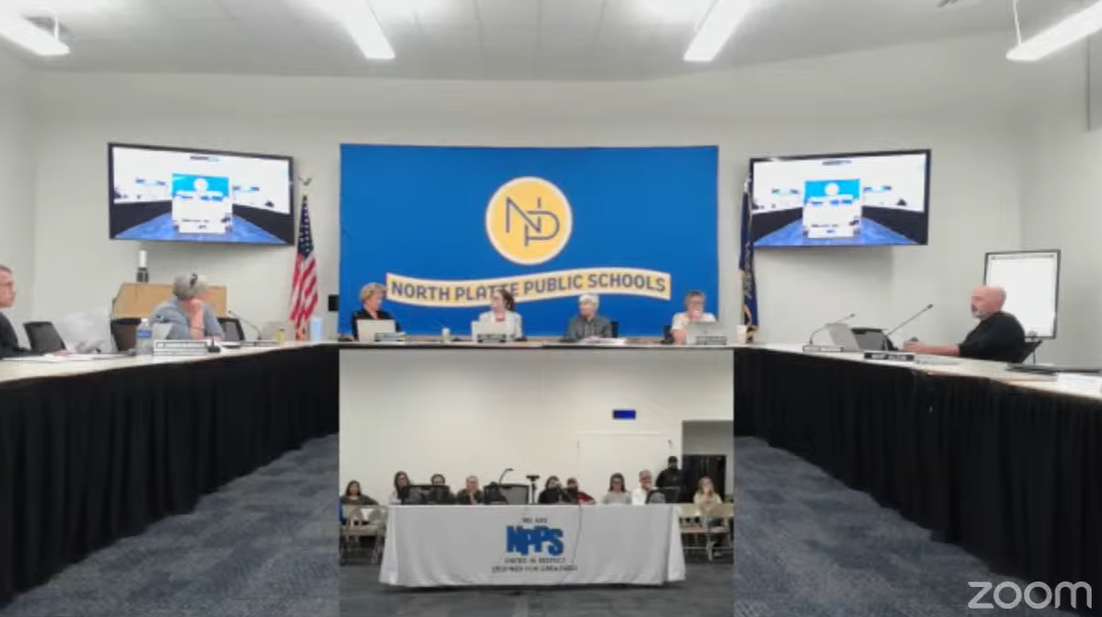
The North Platte Public Schools Board of Education approved its 2026-27 budget Thursday night after more than three hours of public comment, discussion and debate, ultimately settling on Scenario C in a 3-2 vote.
The board also approved the corresponding property tax request on a separate 4-1 vote.
The final budget comes as the district faces declining state aid, limited unrestricted cash reserves and millions of dollars in anticipated building and maintenance needs. The district’s total 2026-27 budget is approximately $68.98 million.
The board meeting on Sept. 24 was the final step in a budget process that had included multiple possible tax-request scenarios. Board member Skip Altig was absent, leaving five members present: Emily Garrick, Angela Blaesi, Mitch Wagner, Cindy O’Connor and JoAnn Lundgreen. With five members present, three votes were needed for a majority.
Before the final vote, board members considered Scenario B, Scenario D and finally Scenario C.
Scenario B, which carried a total property tax request of $35,244,389, failed on a 2-3 vote. Garrick and Blaesi voted in favor, while Lundgreen, O’Connor and Wagner voted against it.
The board then considered Scenario D, the highest of the four A-through-D proposals on the final budget sheet. Scenario D carried a $36,254,490 total property tax request. It also failed 2-3, with Lundgreen and O’Connor voting yes and Garrick, Blaesi and Wagner voting no.
That left Scenario C.
Scenario C carried a total property tax request of $35,749,439 and was the second-highest of the A-through-D proposals on the final budget sheet. It passed 3-2, with Wagner, Lundgreen and O’Connor voting yes. Garrick and Blaesi voted no.
The final vote came after an extended discussion about the district's financial position and the effect of property valuations on the tax request.
During that discussion, Wagner described the situation facing the district as an “un-win-able situation.”
“I don't want to raise taxes, but at the same time, I don't want our teachers to leave us either,” Wagner said during the discussion. He also said he did not want longtime residents on fixed incomes to be forced to move because of higher taxes.
“We're in an unwinable situation here. No matter what we do,” Wagner said.
What Scenario C means
Under Scenario C, the district's general fund budget is approximately $58.97 million. The scenario includes about $1 million intended to help rebuild the district's cash reserves, although administrators said future expenses such as HVAC systems, roofs, aging buses and vans could affect how much ultimately remains available for reserves.
The district's final property tax request includes $35,294,894 for the General Fund, $353,535 for the Special Building Fund and $101,010 for the Qualified Capital Purpose Undertaking Fund. There is no bond fund request in the resolution.
The resulting property tax rate is 0.991093 per $100 of assessed valuation. The resolution states that, because the district's total assessed valuation increased by 7.39%, a levy of 0.872165 per $100 would have generated approximately the same amount of property tax revenue as the previous year.
The district's total property tax request under Scenario C represents a 13.64% increase over the previous year's total property tax request. That figure refers specifically to the amount of property tax the district is requesting to collect — it is not a 13.64% increase in the district's overall budget. During Thursday's discussion, administrators specifically clarified that the overall budget increase is lower because of changes in state aid and other revenue.
That distinction became an important part of the board's discussion because several members questioned how the increase should be characterized when communicating with taxpayers.
The district's certified valuation increased from approximately $3.359 billion in 2025-26 to approximately $3.607 billion for 2026-27, an increase of about 7.4%. Administrators emphasized that an increase in the district's overall valuation does not mean every individual property owner's taxes will increase by the same percentage. Individual tax bills depend on the taxable value of the property and the levies imposed by all taxing entities.
Why the district says more money is needed
District administrators have repeatedly pointed to several factors behind the budget pressure.
State funding is expected to be approximately $1.6 million lower, while the district continues to face personnel, insurance, fuel, transportation, building operations and other operating costs. Administrators also said the district has been working to reduce its reliance on interfund borrowing and improve the General Fund's cash position.
Assistant Superintendent Damon McDonald said Scenario A essentially represents a zero-based approach that would not build the district's reserves. He said choosing that scenario would require additional reductions across the district.
Scenario B represented approximately a $500,000 investment toward the district's financial position, while Scenario C represented approximately a $1 million investment.
Administrators also warned that the district still has work to do even with Scenario C. Roof replacements, HVAC needs, transportation costs and other maintenance requirements are expected to continue putting pressure on district finances. McDonald said the district will still need to examine programs and departments for possible reductions moving forward.
The district has previously estimated that building repairs and maintenance needs could total between $2 million and $4 million.
The property tax vote
After the board approved Scenario C, it took a brief recess before considering the separate property tax request resolution.
The resolution passed 4-1.
Wagner, Lundgreen, O'Connor and Blaesi voted in favor. Garrick voted against it.
Blaesi explained before the vote that her earlier opposition to the budget scenario was more about the associated tax request than the budget itself. She said she wanted the district to pursue additional revenue sources, including grants, as part of the process going forward.
The board's work is not finished
Board members acknowledged throughout the meeting that approving the budget does not resolve all of the district's financial challenges.
After Scenario C passed, the board president told members and those attending the meeting that the budget vote was only the beginning of the work. The district will still have to address reductions, reserves, revenue and long-term financial needs.
The district's financial situation has been a subject of debate throughout the budget process, with some taxpayers calling for reductions in spending and others warning that significant cuts could affect staffing, programs and services for students.
The board ultimately settled between the lower Scenario B and higher Scenario D, selecting Scenario C after both alternatives failed.
The 2026-27 budget and property tax request now move forward under Scenario C, with district officials expected to continue working on spending reductions, cash reserves and additional revenue sources during the coming school year.