Letter to federal officials seeks answers on what happens to state’s remaining $360 million in federal funds
By Aaron Sanderford | Nebraska Examiner

LINCOLN — Nebraska Gov. Jim Pillen might find some federal help in his efforts to steer about $360 million in unspent funds Congress earmarked for rural broadband development in Nebraska toward other uses that his administration argues will boost connectivity.
Chief among Pillen’s ideas is boosting wireless connectivity in rural areas where modern farming and ranching needs require the kinds of internet connections that power precision agriculture demands in a rising age of artificial intelligence and agricultural technology.

The letter asks federal broadband funding officials to allow the funds to be used in precision agriculture, including livestock monitors, remote field and cattle management systems, sensors and guidance systems for automated agricultural equipment.
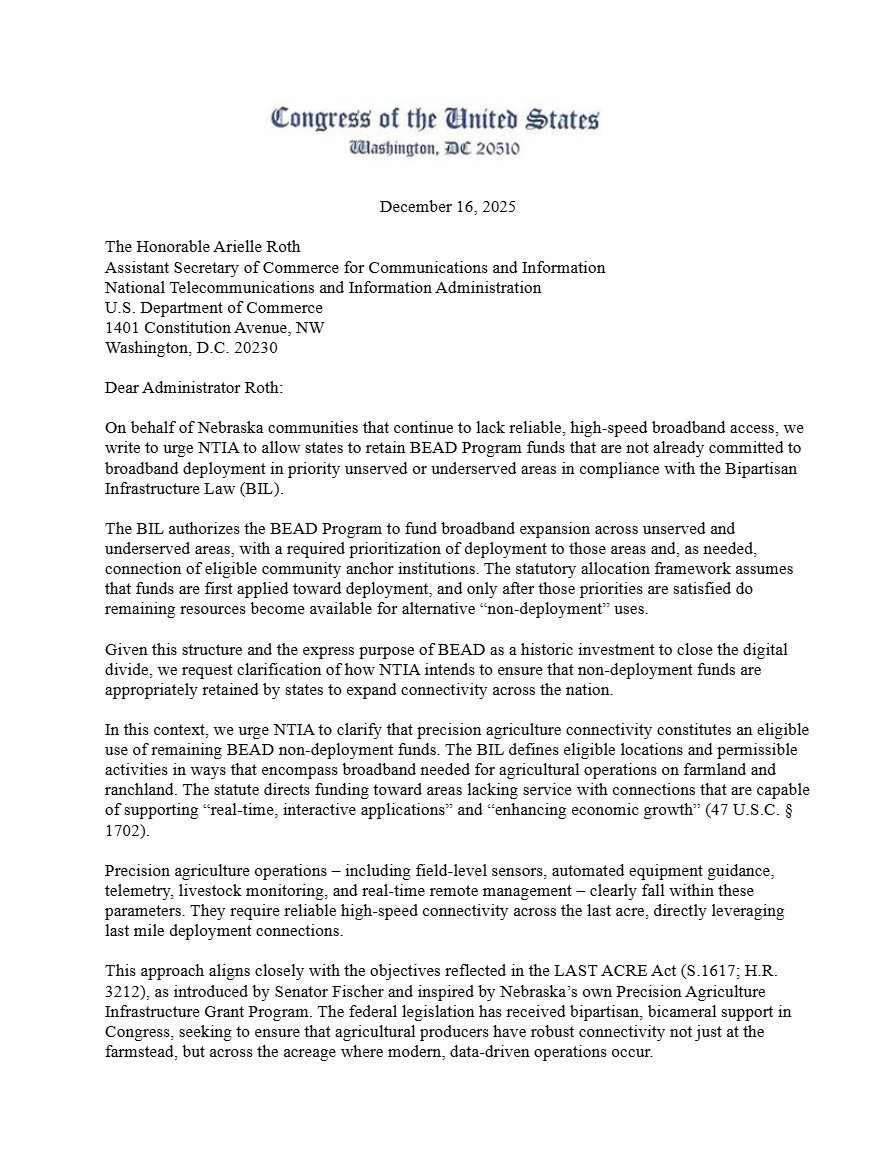
All five members of Nebraska’s congressional delegation signed onto a letter Tuesday seeking agency help from Arielle Roth, assistant secretary of commerce for communications and information at the National Telecommunications and Information Administration.
The letter was organized by U.S. Sen. Deb Fischer, R-Neb., who chairs the Senate Commerce Committee’s Telecommunications and Media Subcommittee. Among the Nebraskans in Congress, she and U.S. Rep. Don Bacon, R-Neb., voted for the 2021 infrastructure bill. U.S. Sen. Pete Ricketts, R-Neb., and U.S. Reps. Mike Flood, R-Neb., and Adrian Smith, R-Neb., joined the letter this week.
Fischer, as part of the infrastructure bill that passed under the Biden administration, supported parts of the infrastructure law that focused on rural broadband, including the last mile between connection nodes and the people and businesses needing broadband. The letter cites language from the broader law to seek the funds.
The delegation letter calls for Roth and NTIA to clarify how states can use any funds not obligated under the state’s approved plan for the Broadband Equity Access and Deployment program, or BEAD. Some supporters of fiber broadband connections have questioned Nebraska’s approach.
“The statutory allocation framework assumes that funds are first applied toward deployment, and only after those priorities are satisfied do remaining resources become available for alternative, ‘non-deployment’ uses,” the delegation wrote.
“Given this structure and the express purpose of BEAD as a historic investment to close the digital divide, we request clarification on how NTIA intends to ensure that non-deployment funds are used appropriately to expand connectivity across the nation.”
The Pillen administration’s plan for the broadband funds, the broad outlines of which the federal government recently approved, would spend $44.5 million of the $405 million Nebraska was awarded through BEAD. The governor has said he would like the state to be able to spend the remaining funds on precision agriculture and other similar efforts. Doing so would require federal approval.
State officials have argued that rules for spending the broadband funds were tightened in the middle of the process, limiting which addresses they could help with built-out broadband, because some were served in other ways. Critics worry the state might lose the remaining funds.
Pillen and his team have argued the money should be made available for the last-mile connections that matter to farm and ranch families and people for whom traditional fiber broadband connections might be prohibitively expensive.
The plan’s critics have argued that his more reserved approach to spending the funds and his willingness to allow a mix of wireless and wireline broadband will leave some Nebraskans with second-class connections in a digital economy that demands access.
State Sens. Jana Hughes of Seward and Wendy DeBoer of Omaha joined a bipartisan group of more than 160 state lawmakers nationwide last week in a similar letter to Roth and U.S. Secretary of Commerce Howard Lutnick to release the non-deployed BEAD funds.
“We respectfully ask that the Department of Commerce act swiftly to release non-deployment funds so that states can complete the job of closing the digital divide,” the Dec. 9 letter said. “Bipartisan leaders at every level — governors, members of Congress and state legislators — support unlocking these funds.
“To do otherwise would ignore the law and leave rural and disconnected Americans behind.”
Nebraska Examiner reporters Zach Wendling and Erin Bamer contributed to this report.